Form Four Mathematics – Trigonometry
Mathematics revision
In a right triangle, identify the angle you are working with before labelling the opposite and adjacent sides. The hypotenuse is always opposite the right angle.
Choose the correct ratio
If the side opposite an angle is 3 cm and the hypotenuse is 5 cm, its sine is 3 ÷ 5 = 0.6.
Practice question
For an angle with opposite side 6 cm and adjacent side 8 cm, find its tangent.
Check your answer
Tangent is opposite ÷ adjacent, so 6 ÷ 8 = 0.75.
TRIGONOMETRY
Trigonometry is a branch of mathematics that deals with relationship (s) between angles and sides of triangles.
The Sine, Cosine and Tangent of an Angle Measured in the Clockwise and Anticlockwise Directions
Determine the sine, cosine and tangent of an angle measured in the clockwise and anticlockwise directions
The basic three trigonometrical ratios are sine, cosine and tangent which are written in short as Sin, Cos, and tan respectively.
Consider the following right angled triangle.
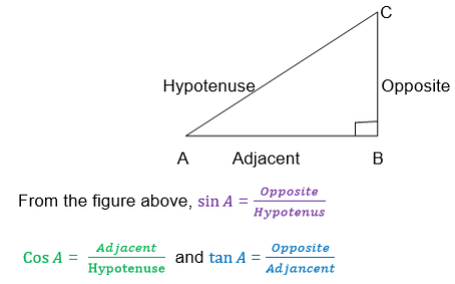
Also we can define the above triangle ratios by using a unit Circle centered at the origin.
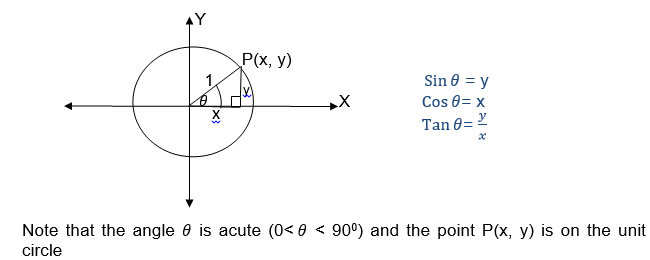
If θis an obtuse angle (900<θ<180 style="box-sizing: border-box;" sup="">0
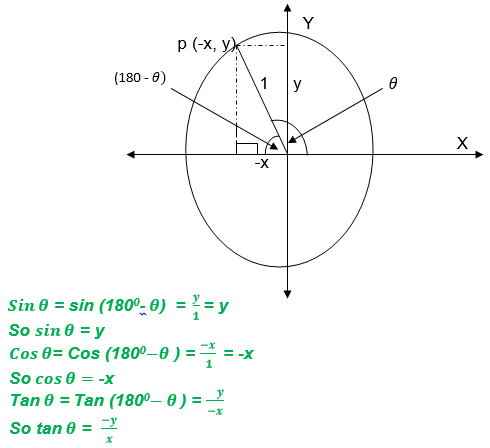
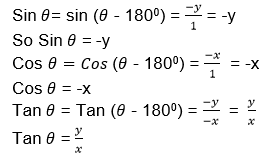
If θis a reflex angle (1800< θ<270 style="box-sizing: border-box;" sup="">0
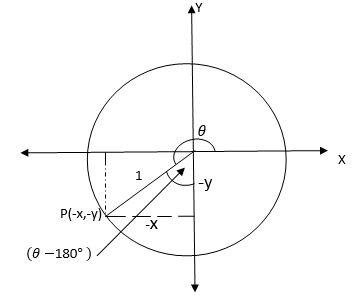
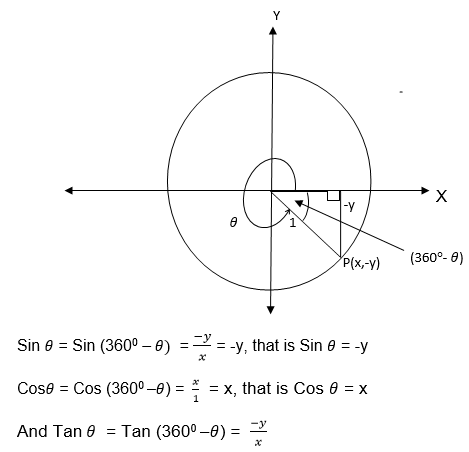
If θis a reflex angle (2700< θ< 3600), then the trigonometrical ratios are the same as that of 3600 -θ
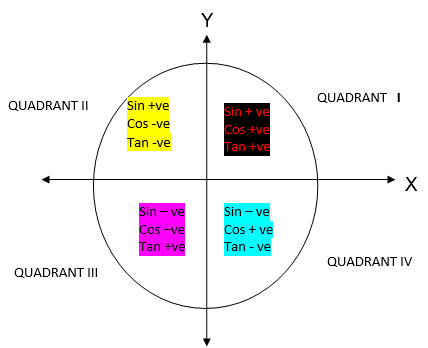
We have seen that trigonometrical ratios are positive or negative depending on the size of the angle and the quadrant in which it is found.
The result can be summarized by using the following diagram.
Trigonometric Ratios to Solve Problems in Daily Life
Apply trigonometric ratios to solve problems in daily life
Example 1
Write the signs of the following ratios
- Sin 1700
- Cos 2400
- Tan 3100
- sin 300
Solution
a)Sin 1700
Since 1700 is in the second quadrant, then Sin 1700 = Sin (1800-1700) = Sin 100
∴Sin 1700 = Sin 100
b) Cos 2400 = -Cos (2400-1800)= -Cos 600
Therefore Cos 2400= -Cos 600
c) Tan 3100 = -Tan (3600-3100) = - Tan 500
Therefore Tan 3100= -Tan 500
d) Sin 3000= -sin (3600-3000) = -sin 600
Therefore sin 3000= - Sin 600
Relationship between Trigonometrical ratios
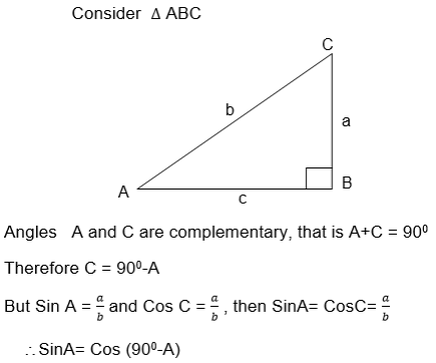
The above relationship shows that the Sine of angle is equal to the cosine of its complement.
Also from the triangle ABC above
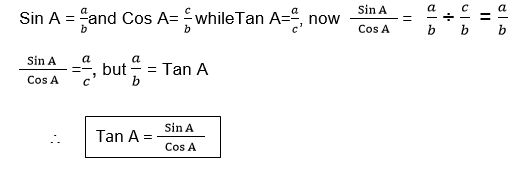
Again using the ΔABC
b2 = a2+c2 (Pythagoras theorem)
And
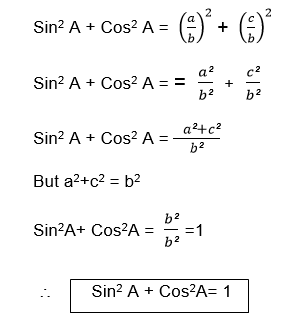
Example 2
Given thatA is an acute angle and Cos A= 0.8, find
- Sin A
- tan A.

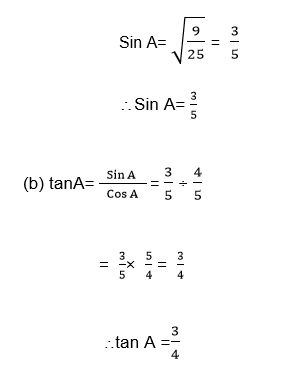
Example 3
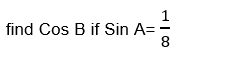
If A and B are complementary angles,
Solution
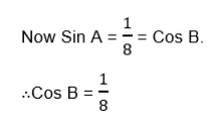
If A and B are complementary angle
Then Sin A = Cos B and Sin B = Cos A
Example 4
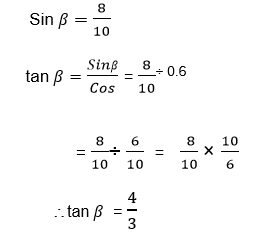
Given that θand βare acute angles such that θ+ β= 900 and Sinθ= 0.6, find tanβ
Solution

Exercise 1

Sines and Cosines of Angles 0 Such That -720°≤ᶿ≥ 720°
Find sines and cosines of angles 0 such that -720°≤ᶿ≥ 720°
Positive and Negative angles
An angle can be either positive or negative.
Definition:
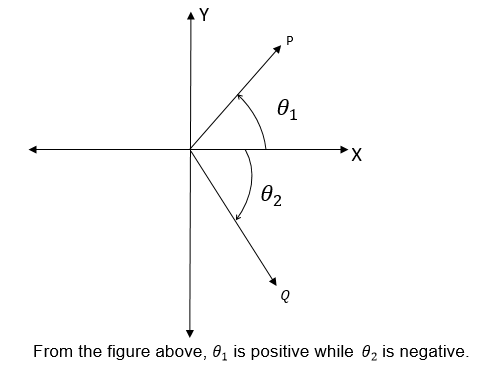
Positive angle: is an angle measures in anticlockwise direction from the positive X- axis
Negative angle: is an angle measured in clockwise direction from the positive X-axis
Facts:
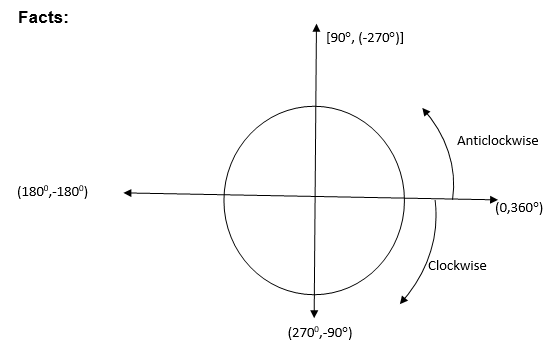
- From the above figure if is a positive angle then the corresponding negative angle to is (- 3600) or (+ - 3600)
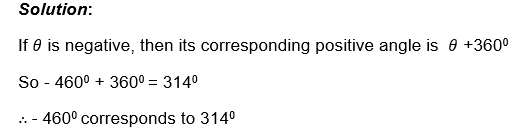
- .If is a negative angle, its corresponding positive angle is (360+)
Example 5
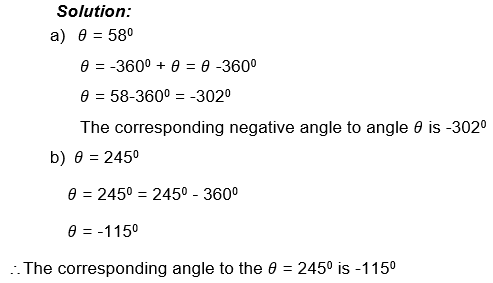
Find thecorresponding negative angle to the angle θif ;
- θ= 580
- θ= 2450
Example 6
What is the positive angle corresponding to - 46°?
SPECIAL ANGLES
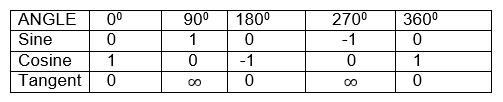
The angles included in this group are 00, 300, 450, 600, 900, 1800, 2700, and 3600
Because the angle 00, 900, 1800, 2700, and 3600, lie on the axes then theirtrigonometrical ratios are summarized in the following table.
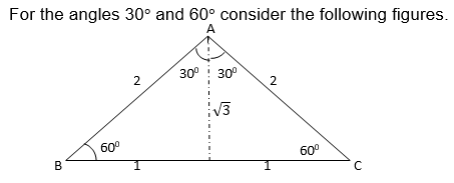
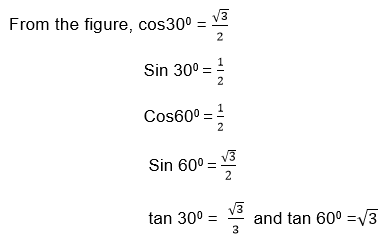
The ∆ ABC is an equilateral triangle of side 2 units
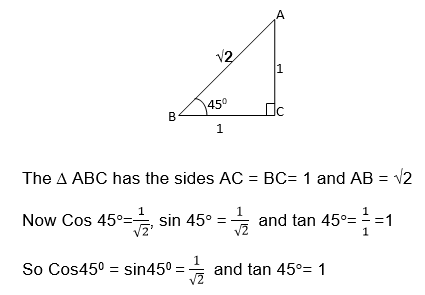
For the angle 450 consider the following triangle
The following table summarizes the Cosine, Sine, and tangent of the angle 300 , 450 and 600
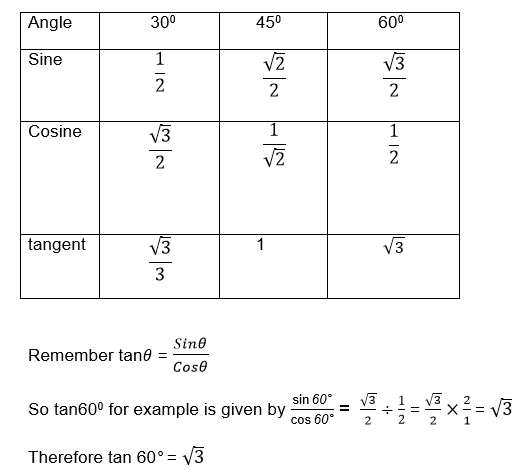
NB: The following figure is helpful to remember the trigonometrical ratios of special angles from 0°to 90°
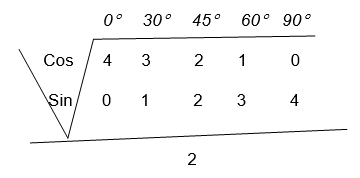
If we need the sines of the above given angles for examples, we only need to take the square root of the number below the given angle and then the result is divided by 2.

Example 7
Find the sine,cosine and tangents of each of the following angles
- -1350
- 1200
- 3300
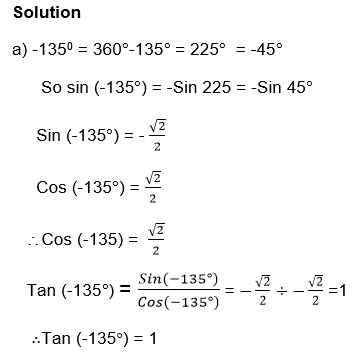
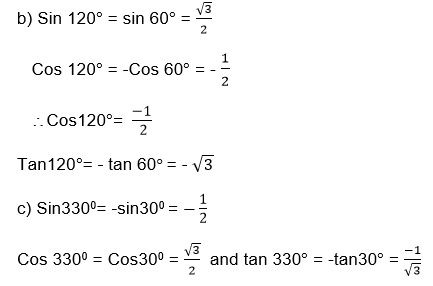
Example 8
Find the value of θif Cos θ= -½ and θ≤ θ≤ 360°
Solution
Since Cos θis – (ve), then θlies in either the second or third quadrants,
Now - Cos (180 –θ= - Cos (θ+1800) = -½= -Cos600
So θ= 1800-600 = 1200 or θ= 1800 + 600 = 2400
θ= 1200 0r θ=2400
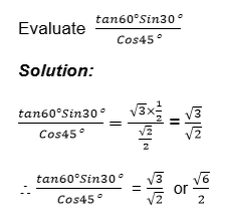
Example 9
Consider below
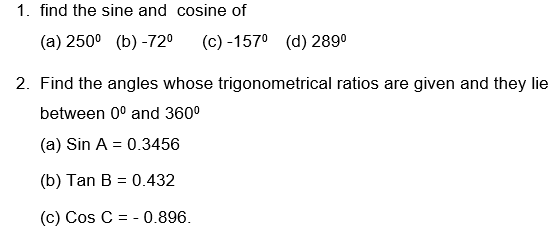
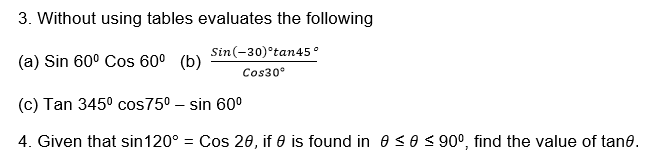
Exercise 2
The Graphs of Sine and Cosine
Draw the graphs of sine and cosine
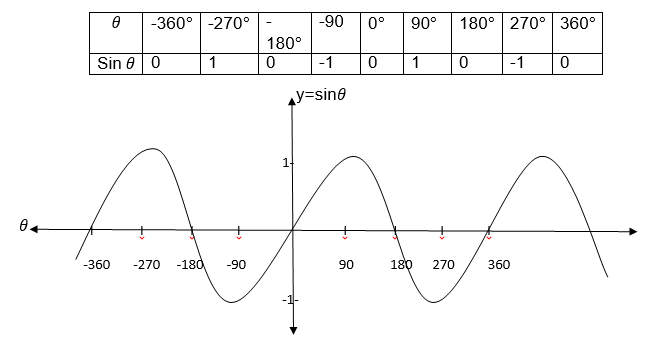
Consider the following table of value for y=sinθ where θranges from - 360°to 360°
For cosine consider the following table of values
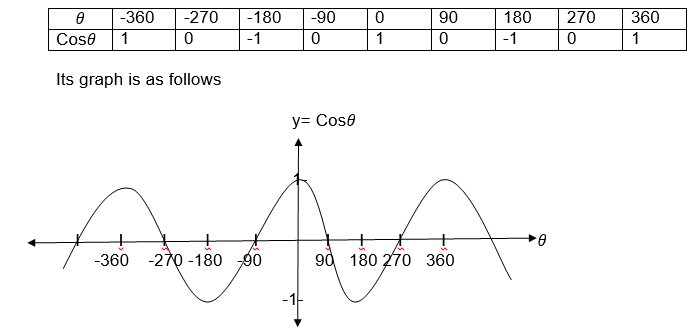
From the graphs for the two functions a reader can notice that sinθand cosθboth lie in the interval -1 and 1 inclusively, that is -1≤sinθ1 and -1≤cosθ≤1 for all values of θ.
The graph of y= tanθis left for the reader as an exercise
NB: -∞≤ tanθ≤∞the symbol ∞means infinite
Also you can observe that both Sinθnd cosθrepeat themselves at the interval of
360°, which means sinθ= sin(θ+360) = sin(θ+2x3600) etc
and Cosθ=(Cosθ+3600)= Cos(θ+2x3600)
Each of these functions is called a period function with a period 3600
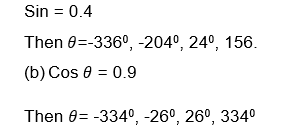
1. Usingtrigonometrical graphs in the interval -3600≤θ≤3600
Find θsuch that
- Sin= 0.4
- Cos= 0.9
solution
Example 10
Use the graph of sinθto find the value ofθif
4Sinθ= -1.8 and -3600 ≤θ≤3600
Solution
4Sinθ= -1.8
Sinθ= -1.8÷4 = -0.45
Sinθ= -0.45
So θ= -1530, -270, 2070, 3330
The graphs of sine and cosine functions
Interpret the graphs of sine and cosine functions
Example 11
Use thetrigonometrical function graphs for sine and cosine to find the value of
- Sin (-400)
- Cos (-400)
Solution
- Sin (-400)= - 0.64
- Cos (-400)= 0.76
The Sine and Cosine Rules
Derive the sine and cosine rules
Consider the triangle ABC drawn on a coordinate plane
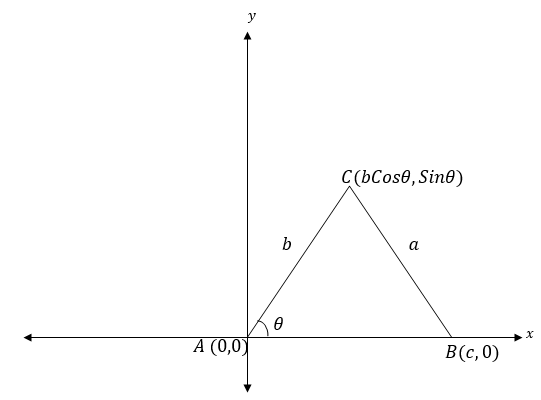
From the figure above the coordinates of A, B and C are (0, 0), (c, 0) and(bCosθ, bSinθ) respectively.
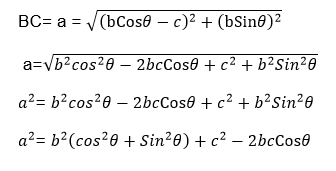
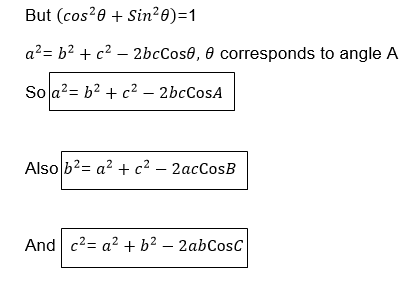
Now by using the distance formula
SINE RULE
Consider the triangle ABC below
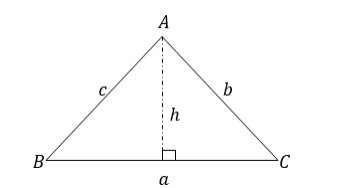
From the figure above,
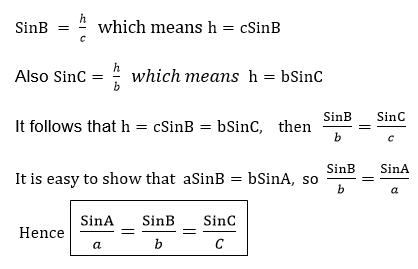
Note that this rule can be started as “In any triangle the side are proportional to the Sines of the opposite angles”
The Sine and Cosine Rules in Solving Problems on Triangles
Apply the sine and cosine rules in solving problems on triangles
Example 12
Find the unknown side and angle in a triangle ABC given that
a= 7.5cm
c= 8.6cm and C= 80°
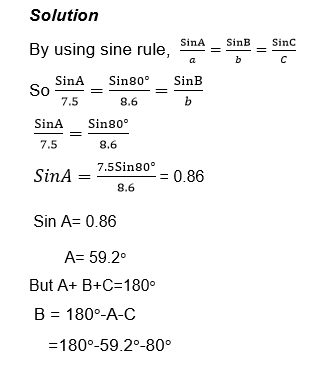
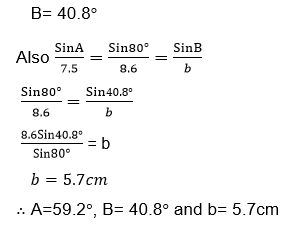
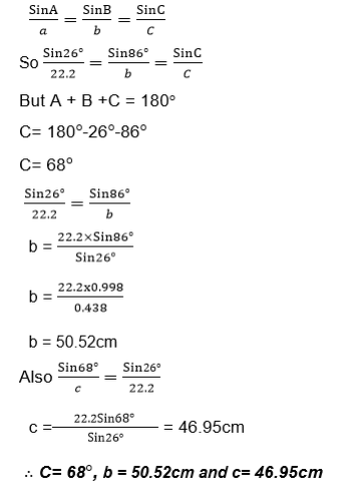
Find the unknown sides and angle in a triangle ABC in which a= 22.2cmB= 86°and A= 26°
Solution
By sine rule
Sin A= sin B= Sin C
Example 13
Find unknown sides and angles in triangle ABC
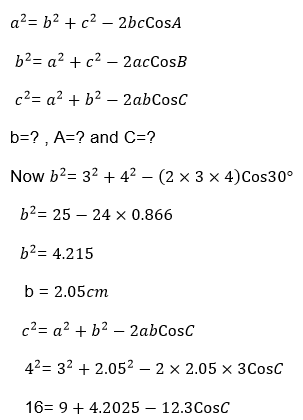
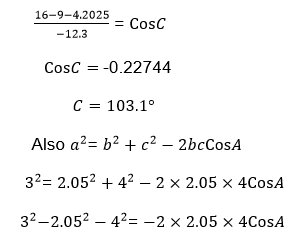
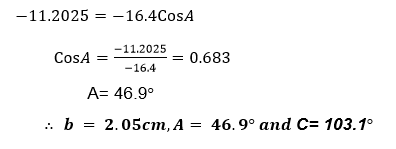
Where a=3cm, c= 4cm and B= 30°
Solution
By cosine rule,
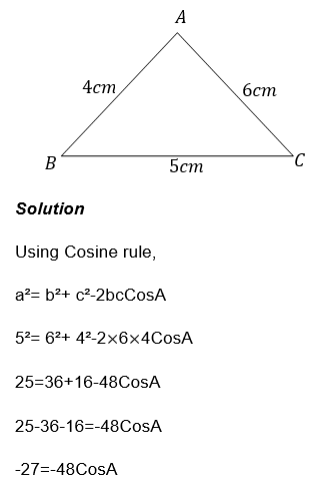
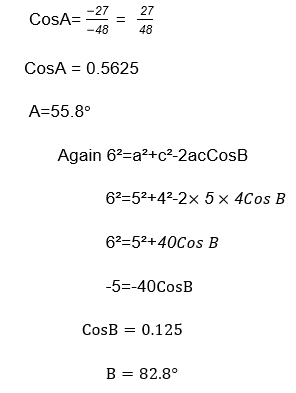
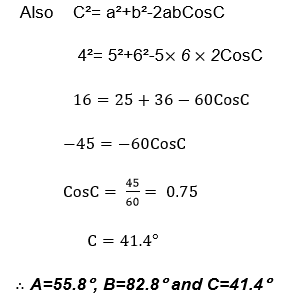
Example 14
Find the unknown angles in the following triangle
Exercise 3
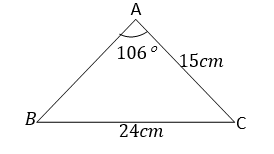
The Compound of Angle Formulae or Sine, Cosine and Tangent in Solving Trigonometric Problems
Apply the compound of angle formulae or sine, cosine and tangent in solving trigonometric problems
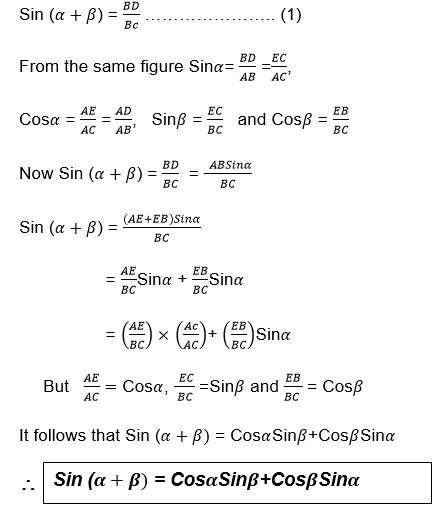
The aim is to express Sin (α±β) and Cos (α±β) in terms of Sinα, Sinβ, Cosαand Cosβ
Consider the following diagram:
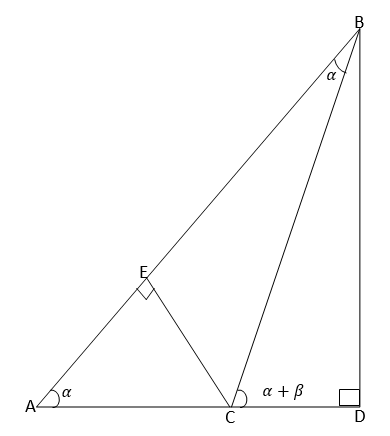
From the figure above
From ΔBCD
For Cos(α±β) Consider the following unit circle with points P and Q on it such that OP,makes angleα with positive x-axis and OQ makes angle βwith positive x-axes.
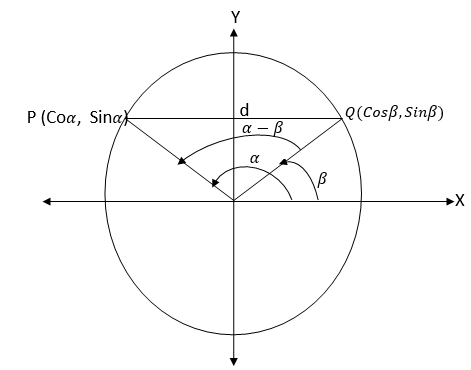
From the figure above the distance d is given by
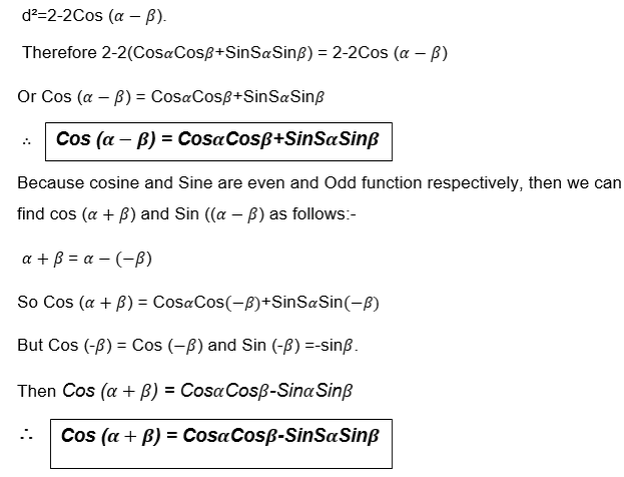
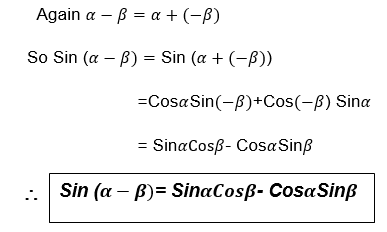
In general
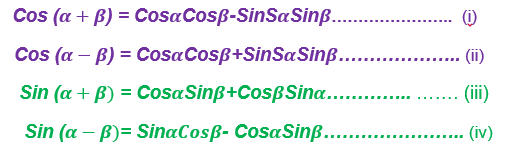
Example 15
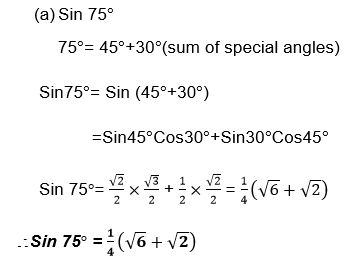
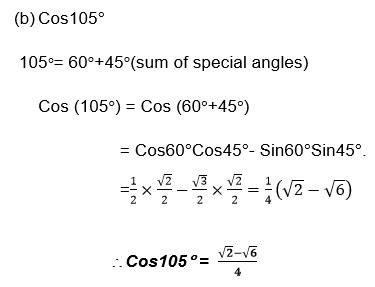
1. Without using tables find the value of each of the following:
- Sin 75°
- Cos 105
Solution:
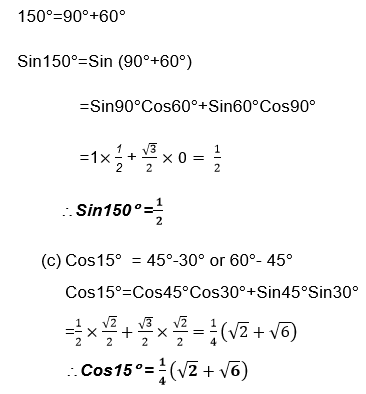
Example 16
Find:
- Sin150°
- Cos 15°
Exercise 4
- READ TOPIC 6: Vectors
- READ TOPIC 6: Vectors
This is the good for all form four students
ReplyDelete